Que Sera Sera Meaning
Do you know the about Que Sera Sera meaning? Have you ever found yourself worrying about what the future holds or trying to control every little detail of your life?
Sometimes, no matter how much we plan, things don’t always go the way we expect.
That’s where the phrase “que sera sera” comes in! Meaning “whatever will be, will be,” this simple yet powerful saying reminds us to let go of the need to control everything and trust that things will work out as they are meant to.
In this post, we’ll explore the true meaning of “que sera sera,” its history, and how it can help us live more peacefully, without stressing over what’s to come
What Does “Que Sera Sera” Mean?
Que sera sera is a Spanish phrase that translates to whatever will be, will be in English.
It’s a reminder that some things in life are simply out of our control, and no matter how much we plan, hope, or worry about them, the future will unfold the way it’s meant to.
The phrase suggests a sense of acceptance and peace with life’s uncertainties.
At its heart, “que sera sera” conveys the idea that worrying about what will happen tomorrow is not only unproductive but also unnecessary.
Life is full of surprises, some pleasant and others challenging, but what truly matters is how we deal with these moments as they come.
This phrase encourages us to let go of our need to control every aspect of our lives and embrace the unknown.
It’s often used to express a carefree attitude toward the future.
If someone is anxious about a big decision or unsure of what lies ahead, you might hear them say “que sera sera” as a way to say, “I’ll let life take its course.” It’s a way of acknowledging that no matter how much we try to plan or predict, the outcome is often beyond our control.
The phrase doesn’t imply that we should abandon our responsibilities or stop making decisions—it’s more about finding peace with the things we can’t control.
It’s a gentle reminder to trust the process, stay present, and have faith that things will unfold as they should.
In a world where we’re often taught to be proactive and plan for the future, “que sera sera” offers a refreshing perspective.
It teaches us to accept uncertainty and live in the moment, letting go of the need to predict or control every part of our journey.
Definition of “Que Sera Sera”
“Que sera sera” is a phrase that originates from Spanish, and its direct translation to English is “whatever will be, will be.”
It is an expression of acceptance and resignation to the unpredictability of life, emphasizing the belief that some things are beyond our control.
The phrase encourages us to let go of worries about the future and trust that things will work out as they are meant to, no matter what.
In essence, it suggests that we should stop stressing over things that are outside our influence, and instead, embrace the uncertainty with a peaceful mindset.
The phrase reflects a philosophy of living in the present, focusing on what can be done now, and leaving the future to unfold on its own.
It’s about acknowledging that, sometimes, despite our best efforts, the outcome is not up to us, and that’s okay.
Examples of “Que Sera Sera” in Use
- Dealing with Career Uncertainty: Imagine someone who is unsure about their career path and is feeling anxious about making the right choice. They might be contemplating whether to take a new job offer or stay in their current position, both of which come with risks. In this situation, someone might say, “I’ve worked so hard for this opportunity, but if it doesn’t work out, que sera sera. I’ll figure it out when the time comes.” Here, the phrase expresses a calm acceptance of whatever happens next, knowing that no matter what choice they make, they’ll adapt to the outcome.
- Handling Relationship Changes: Think about a person who is going through a difficult time in their relationship, perhaps facing a breakup or unsure of what the future holds with their partner. They might reflect on the situation and say, “We’ve tried our best, but if it’s not meant to be, que sera sera.” In this case, the phrase represents the idea of letting go of the need to control the outcome and accepting that the relationship may naturally evolve in a way that’s beyond their control.
- Accepting Life’s Unpredictability: Imagine someone planning a wedding, but things aren’t going according to plan—there are delays, mistakes, and unexpected challenges. In the midst of it all, they might say, “I’ve done everything I can to make it perfect, but if something goes wrong, que sera sera. It will still be a beautiful day.” This illustrates how the phrase can be used to let go of perfectionism and embrace whatever happens, knowing that some things simply can’t be planned for.
- Facing a Health Diagnosis: A person who has received a difficult health diagnosis might say, “The doctors have given me their best advice, but I can’t control how things will turn out. Que sera sera. I’ll focus on staying positive and taking it one day at a time.” Here, the phrase is used to express acceptance and calm in the face of something that is beyond their control, focusing on what they can manage in the present moment.
“Que sera sera” means “whatever will be, will be” and serves as a reminder to accept life’s uncertainties.
It’s often used to express calmness and peace when facing situations that are out of one’s control.
The phrase can be applied to various life situations, such as career decisions, relationships, or unexpected challenges.
Through these examples, you can see how the phrase encourages a relaxed, accepting attitude toward life’s unpredictable nature.
It helps people navigate moments of uncertainty with grace and confidence, trusting that the future will unfold as it should, regardless of how much control we may wish to have over it.
Word Origin of “Que Sera Sera”
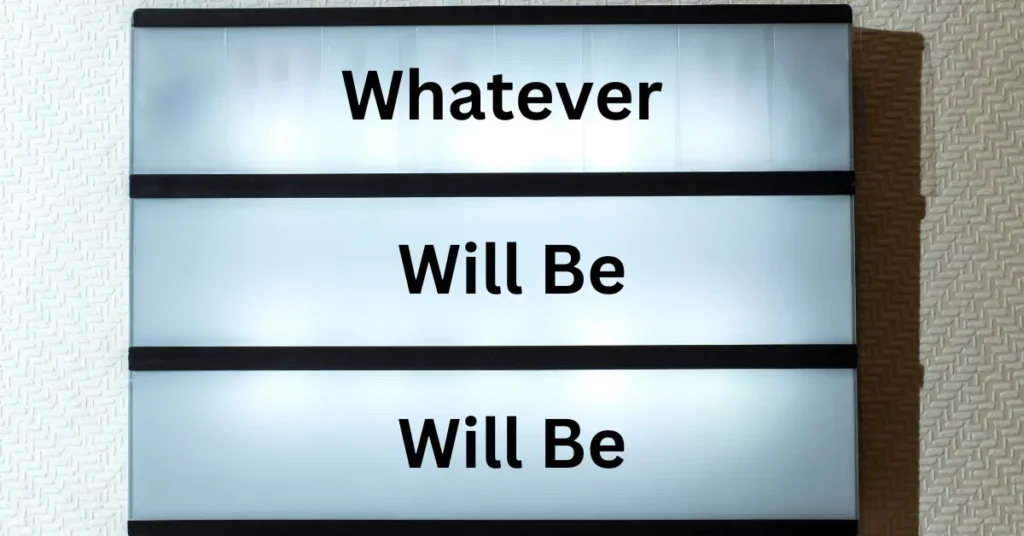
The phrase “que sera sera” has its roots in the Spanish language, with “que” meaning “what,” “sera” meaning “will be” (from the verb ser, which means “to be”), and a repeated “sera” for emphasis.
So, the literal translation is “what will be, will be.” It reflects the idea that the future is uncertain and, often, beyond our control—essentially conveying the sentiment that whatever happens, happens.
While the phrase itself has existed in various forms across different cultures, it was popularized and immortalized in the English-speaking world primarily through the 1956 hit song “Que Sera, Sera (Whatever Will Be, Will Be)” by Doris Day.
The song was written by the famous songwriting duo Jay Livingston and Ray Evans and became a key part of the Alfred Hitchcock film The Man Who Knew Too Much.
The song’s popularity skyrocketed, and with it, the phrase “que sera sera” became widely recognized, solidifying its place in modern popular culture.
The phrase “que sera sera” is much older than the song, though. It is believed to have been in use in Spanish-speaking countries long before it entered the mainstream English vocabulary.
In Spanish, it often appears in both casual conversation and literature, evoking the same meaning of accepting life’s uncertainties.
The repetition of the word sera (which means “will be”) adds a rhythmic, almost comforting quality to the phrase, reinforcing the notion of letting go and accepting the flow of life.
While the song brought the phrase into global awareness, the concept it conveys is timeless and universal, often associated with ideas of fate, destiny, and acceptance.
Various cultures throughout history have had similar expressions, focusing on the unpredictability of life and the importance of accepting whatever comes our way.
In a broader historical context, the idea of fate and things being beyond one’s control has been present in many philosophical traditions, from ancient Greek philosophy to more modern existentialist views.
The phrase “que sera sera” taps into this shared human experience of surrendering to forces larger than oneself.
“Que sera sera” is a Spanish phrase meaning “whatever will be, will be.”
The phrase became widely popular in the English-speaking world after being featured in the 1956 Doris Day song for The Man Who Knew Too Much.
Though the song made it famous, the sentiment has been part of Spanish and other cultures for centuries.
The idea behind the phrase—accepting uncertainty and trusting that life will unfold as it’s meant to—has deep philosophical roots and continues to resonate with people today.
Through this combination of language and history, “que sera sera” has come to symbolize a calm acceptance of life’s unpredictability, offering a gentle reminder to let go of anxiety and trust that whatever happens, happens for a reason.
FAQs
What does “que sera sera” mean?
“Que sera sera” is a Spanish phrase that translates to “whatever will be, will be” in English. It conveys the idea of accepting life’s uncertainties and the things that are beyond our control. The phrase encourages letting go of worry and trusting that the future will unfold as it’s meant to.
Is “que sera sera” used only in Spanish-speaking countries?
No, “que sera sera” is originally a Spanish phrase, but it became widely popular in English-speaking countries due to the famous 1956 song by Doris Day, “Que Sera, Sera (Whatever Will Be, Will Be).” It is now used in many different languages and cultures as a way to express acceptance of life’s unpredictability.
Where did the phrase “que sera sera” come from?
The phrase “que sera sera” has roots in the Spanish language and has been used for centuries in Spanish-speaking cultures. While the exact origins are unclear, it became widely known in the English-speaking world after the release of the song “Que Sera, Sera (Whatever Will Be, Will Be)” in 1956, which was featured in the Alfred Hitchcock film The Man Who Knew Too Much.
Can “que sera sera” be applied to everyday situations?
Yes, absolutely! “Que sera sera” is often used in everyday conversation to express acceptance when faced with uncertainty or situations beyond one’s control. For example, if you’re worried about an upcoming event or decision, saying “que sera sera” can help relieve anxiety, reminding you that the outcome will unfold as it’s meant to.
Is “que sera sera” a positive or negative phrase?
“Que sera sera” is generally seen as a positive phrase. It promotes peace of mind and encourages acceptance, helping people let go of worries and anxieties about the future. It reminds us that not everything is within our control and that it’s okay to trust the process and embrace life as it comes.
Conclusion
“Que sera sera” is a simple yet powerful phrase that reminds us to let go of worries about the future and accept life’s uncertainties.
It teaches us that, no matter how much we plan or try to control things, some things are simply beyond our control.
Embracing the idea that “whatever will be, will be” can bring peace and help us navigate life’s ups and downs with a calm, positive mindset.
So, the next time you’re feeling anxious about what’s to come, remember: que sera sera – whatever happens, happens.
Extra Points on “Que Sera Sera”
- A Universal Message: While “que sera sera” comes from Spanish, its meaning is understood around the world. People from all cultures can relate to its message of accepting life’s uncertainties and trusting that things will work out in the end.
- A Reminder to Stay Calm: In a world where we’re often overwhelmed with planning and controlling every detail of our lives, “que sera sera” serves as a gentle reminder to take a step back and breathe. It’s okay not to have all the answers right now.
- Popular in Songs and Movies: The phrase became famous thanks to Doris Day’s hit song, but it has also appeared in countless films, books, and other songs. It’s often used to represent a carefree or hopeful attitude toward life’s challenges.
- Helps in Tough Times: “Que sera sera” is especially comforting during tough times when you feel uncertain or stressed. It encourages you to focus on the present, instead of worrying about what’s out of your control.