Suck Meaning in English
Have you ever wondered about the word suck meaning in English? It’s one of those words that can be used in different ways, and its meaning might change depending on the situation.
The most common use of “suck” is when we talk about pulling in liquid or air through our mouths, like when you drink through a straw.
But did you know it also has other meanings, including some in slang and informal speech?
In this article, we’ll break down what “suck meaning in English” really is, explore its history, and show you how it’s used in different contexts.
So, let’s dive in and explore everything there is to know about the word “suck”!
What Does It Mean?
The word “suck” in English primarily refers to the action of drawing liquid or air into your mouth through a vacuum created by your lips.
This action doesn’t involve using your teeth and is usually associated with drinking, breathing, or feeding.
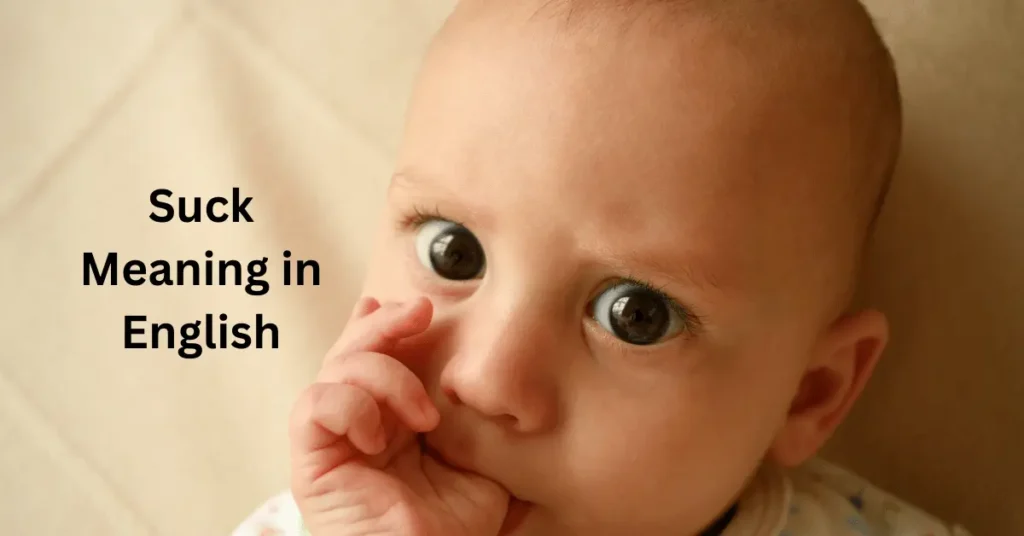
It’s something most of us do without thinking, like when you drink from a straw, suck on a candy, or when a baby suckles from its mother’s breast.
Literal Meaning
At its core, suck refers to a physical action—to pull in liquid or air using your mouth. For example:
Drinking: When you use a straw to drink a beverage, you’re sucking the liquid into your mouth.
Babies and Animals: Newborn babies suck milk from their mother’s breast or a bottle.
Some animals, like calves or puppies, also suckle from their mothers in the same way.
Breathing: If you suck in air through your mouth—whether to cool off or in surprise—you’re engaging in the same basic action.
Figurative Meaning
However, “suck” doesn’t just stop at its physical meaning. Over time, this simple action has also come to describe negative or unpleasant situations.
It’s a great example of how language can evolve!
For instance, when something is considered very bad or disappointing, people often say it “sucks.”
This doesn’t have anything to do with the physical act of sucking but instead refers to something being frustrating or unsatisfactory.
Example
“That movie really sucked” means the movie was bad or disappointing.
Common Expressions Involving “Suck”
“That sucks!”: This is a popular way to express sympathy or frustration about something unpleasant. For example, if someone tells you their flight was delayed, you might say, “Oh man, that sucks!”
“Sucking it up”: This phrase means enduring something unpleasant without complaining. If you’re having a hard time at work but keep going, you might say, “I’m just sucking it up and powering through the day.”
“Suck it up”: Similar to “sucking it up,” this phrase can also be used to tell someone to stop complaining and accept a difficult situation.
In summary, the primary meaning of “suck” is about physically pulling something into your mouth, typically liquid or air.
But it’s also used in a figurative sense to describe something unpleasant, showing just how versatile this simple word can be!
Definition and Examples of “Suck” Meaning in English
The word “suck” has a few different meanings depending on the context in which it is used.
Let’s take a deeper look at the definition and provide clear examples to help you understand how this word works in various situations.
To Draw Liquid or Air into Your Mouth (Literal Meaning)
At its core, “suck” means to draw in liquid or air through your mouth without using your teeth, often by creating a vacuum with your lips.
This is the most basic and physical meaning of the word. It’s an action that everyone has done at some point, whether they realize it or not.
Definition
To pull in or ingest liquid, air, or another substance through your mouth, typically by creating suction.
Examples
- “She sucked on the straw to finish her drink.”
- “The baby sucked on the bottle eagerly.”
- “He sucked in air, feeling winded after the long run.”
This literal meaning of “suck” is the one we most often think of when we imagine using a straw or drinking from a bottle. It’s a natural, instinctive action that people do every day.
To Be Disappointing or Unpleasant (Figurative or Slang Meaning)
In modern, informal English, “suck” has expanded beyond its physical meaning to describe something that is bad, disappointing, or unpleasant. It is often used to express frustration, sympathy, or dissatisfaction with a situation or experience.
Definition
To describe something as being of poor quality, frustrating, or unpleasant, often in a casual or negative way.
Examples
- “That concert sucked. The band didn’t even play my favorite song.”
- “I missed the bus, and now I’m late for work. This day just sucks!”
- “Losing my phone was the worst. It really sucks!”
In these examples, “suck” is used to express dissatisfaction or disappointment. It’s an informal, everyday way of venting about something that didn’t go as expected.
To Perform Poorly (Slang Expression)
“Suck” can also be used to describe someone’s ability (or lack thereof) at doing something. When you say someone “sucks” at something, you’re saying they are bad or ineffective at it.
Definition
To be bad at or ineffective in performing a task or activity.
Examples:
- “He sucks at math, so he’s been studying extra hard for the test.”
- “I really suck at playing the guitar, but I’m trying to get better.”
- “She’s a great singer. I wish I didn’t suck at karaoke.”
In these instances, “suck” is used to describe someone’s lack of skill or ability in a particular area. It’s a way of saying someone isn’t performing at a high level or is struggling.
Suck as an Idiomatic Expression
In addition to the meanings above, “suck” is often used in idiomatic expressions or slang phrases that don’t always make sense literally. These expressions can convey a range of emotions, from annoyance to encouragement.
Examples of Idiomatic Expressions
“Suck it up”: This phrase means to endure something unpleasant without complaining or to accept a difficult situation.
“I know the hike is tough, but just suck it up and keep going!”
“Suck up to someone”: This means to flatter someone excessively, often to gain favor or approval.
“He’s always sucking up to the boss to get promoted.”
“Suck the life out of (someone)”: This expression means to drain someone’s energy, enthusiasm, or vitality.
“The constant negativity at work is really sucking the life out of me.”
To recap, the word “suck” in English can mean:
- The physical act of pulling liquid or air into your mouth (like drinking from a straw).
- A negative expression describing something unpleasant or disappointing.
- A casual way of saying someone is bad at something.
- A variety of idiomatic expressions that are widely used in everyday speech.
By understanding both the literal and figurative meanings of “suck,” you can use this word in various situations, whether you’re describing a drink, expressing frustration, or talking about someone’s skills!
Word Origin of “Suck”

The word “suck” has a long and rich history that traces back to Old English and other Germanic languages.
Understanding the origin of “suck” gives us a glimpse into how this simple word evolved over time to become a versatile part of modern English.
Old English Roots
The word “suck” in English can be traced back to the Old English word “sūcan” (pronounced something like “soo-kan”), which meant “to suck” or “to draw in by mouth.”
This word has been used for centuries, long before the modern meanings of “suck” expanded into figurative expressions.
- Old English: sūcan (meaning to suck, draw in, or absorb)
- Proto-Germanic: sūkjan (the root form)
- Proto-Indo-European (PIE): seuk-, which also meant “to suck.”
The word is believed to have descended from the Proto-Indo-European (PIE) root seuk-, which referred to the act of drawing in liquid or air.
The PIE root is the ancient ancestor of many words in different Indo-European languages that refer to the action of sucking, drawing in, or consuming through the mouth.
Evolution Through Time
As Old English evolved into Middle English and then Modern English, the word “suck” maintained its basic meaning of drawing in liquid or air through the mouth.
However, it wasn’t just the literal meaning that stuck around—it also began to take on more figurative uses over time.
Middle English (circa 12th to 15th century): The word evolved into the form “sucken”, with the same meaning of “to suck” or “to draw in,” much like its Old English predecessor.
The concept remained largely unchanged, referring to actions like nursing or drawing in liquids through the mouth.
Early Modern English (circa 16th century): By this time, English had already begun adopting a more informal, colloquial tone in its usage.
This is when we start to see the figurative use of the word “suck” appear. Phrases like “that sucks” (to describe something unpleasant) began to emerge, showing how language evolves as society changes.
These slang uses of “suck” are believed to have originated from expressions in both English and other Germanic languages.
Suck in Other Languages
Interestingly, the word “suck” or its equivalents in related languages often share a similar meaning, reinforcing the word’s ancient roots. Here are some examples of how “suck” or related words appear in other languages:
- German: saugen (to suck)
- Dutch: zuigen (to suck)
- Swedish: suga (to suck)
- French: sucer (to suck)
- Latin: sugere (to suck, draw in)
As we can see, many of these words share similarities with the Old English “sūcan” and its Indo-European roots, showing the deep linguistic connections between English and its European relatives.
The Slang and Figurative Use
The figurative use of “suck” to describe something unpleasant or disappointing likely began in the 20th century, particularly in American English.
The first recorded use of “suck” in this slang sense appeared in the 1930s and 1940s, especially in jazz and street culture.
The phrase “that sucks” became a way to express frustration or dissatisfaction with a situation, similar to how “that stinks” or “that’s bad” might be used.
By the 1960s and 1970s, the phrase “that sucks” had gained widespread popularity and became firmly entrenched in casual, everyday language.
Today, it is a standard part of informal speech, often used to comment on something unpleasant or of poor quality.
The word “suck” has a deep history that goes back to Old English and even further to Proto-Indo-European roots.
Originally referring to the physical action of drawing in liquid or air, the word “suck” gradually developed figurative meanings and became a key part of modern slang.
Its evolution reflects the way language changes over time, adapting to new social contexts and cultural influences.
Understanding the word’s origin highlights not only its rich history but also its flexibility and ability to take on new meanings as language evolves.
FAQs
What is the literal meaning of the word “suck” in English?
The literal meaning of “suck” in English refers to the action of drawing liquid or air into your mouth using suction, typically without using your teeth. For example, drinking from a straw or a baby feeding from a bottle are common situations where “suck” is used in its literal sense.
Why does “suck” also mean something is bad or disappointing?
The figurative use of “suck” to mean something bad or disappointing likely developed from the idea of “sucking” being a negative or unpleasant action. Just as we don’t want to experience something unpleasant, we use “suck” to describe situations or experiences that are frustrating or unsatisfactory, like saying “That movie sucked” when it’s not good.
Is “suck” considered a rude word?
“Suck” is not inherently rude, but its use can be informal or even slang, depending on the context. While the literal meaning is neutral, the figurative use (e.g., “That sucks”) can be seen as casual or even inappropriate in formal settings. It’s best used in informal conversations or with friends rather than in professional or serious contexts.
What does “suck it up” mean?
“Suck it up” is an idiomatic expression that means to endure something unpleasant or difficult without complaining. It’s often used when someone is facing a tough situation and needs to push through it without showing frustration. For example, if you’re tired during a long hike, someone might say, “Come on, suck it up and keep going!”
How did the slang phrase “that sucks” originate?
The slang phrase “that sucks” emerged in the 20th century, particularly in American English, to express frustration or dissatisfaction with a situation. Its use was first recorded in jazz and street culture during the 1930s and 1940s. Over time, it became a widely recognized expression to describe something unpleasant or disappointing.
Conclusion
The word “suck” in English is quite versatile. While its original meaning refers to drawing liquid or air into your mouth, it has also evolved to describe negative situations or express dissatisfaction.
Whether you’re using it literally, like when drinking through a straw, or figuratively, like saying “that sucks” about something disappointing, the word has become a part of everyday language.
Understanding its different meanings can help you use it in the right context and communicate more effectively. So, the next time you hear “suck,” you’ll know exactly what it means!
Extra Points
- Common Slang Phrases: The word “suck” appears in a lot of informal slang expressions. For example, “suck up to someone” means trying to win someone’s favor by being overly nice, and “sucking the life out of someone” means making someone feel drained or exhausted.
- Not Always Negative: While “suck” is often used to describe something bad, it can also be used in more playful or light-hearted ways. For instance, “That was so much fun! It didn’t suck at all!” is a way of saying something was surprisingly good.
- International Use: Many languages have similar words for “suck” or its actions, which shows how common the concept is. Even though “suck” might sound casual, it’s understood in many cultures around the world.
- Evolving Language: Language is always changing, and “suck” is a great example of how words can shift meaning over time. What started as a simple action for pulling liquid through the mouth has now become a part of everyday speech for many people, especially in slang.
- Avoid in Formal Settings: While “suck” is widely used in informal conversations, it’s best to avoid using it in professional or formal settings. It’s more suited for casual chats with friends or in relaxed environments.