North Star Meaning
What is the North Star meaning? Have you ever looked up at the night sky and noticed a bright star that seems to stay in one place while all the other stars move around?
That star is known as the North Star. But what exactly does “North Star meaning” refer to? In simple terms, the North Star is the star that points almost directly to the Earth’s North Pole.
It’s been used by sailors, travelers, and explorers for centuries to help them find their way.
In this post, we’ll dive into the meaning of the North Star, its history, and why it continues to be so important to people today. Let’s explore together!
What Does It Mean?
The North Star, also known as Polaris, is a star that has an important role in both astronomy and navigation.
The term “North Star” refers to the star that is almost directly aligned with the Earth’s northern axis.
In simpler terms, it means that Polaris is located very close to the point in the sky where the Earth’s northern axis – the invisible line around which the Earth rotates – points.
Because of this unique position, the North Star doesn’t appear to move much in the sky, unlike other stars that seem to travel across the night sky due to the Earth’s rotation.
Instead, Polaris stays nearly in the same spot, making it a constant reference point for direction.
When people in the Northern Hemisphere look up at the night sky, they can easily find the North Star by looking for the constellation Ursa Minor, also known as the Little Dipper.
The two stars at the end of the Big Dipper’s bowl, part of the constellation Ursa Major, point toward the North Star.
For centuries, the North Star has been used as a navigational tool, especially by sailors, explorers, and travelers.
Its ability to stay relatively fixed in the sky makes it an ideal marker for determining which way is north.
So, when you hear the term “North Star,” it’s not just a random bright spot in the sky—it’s a vital point for finding direction and is often associated with guidance, hope, and stability.
North Star Meaning: Definition and Examples
Definition: The North Star, also known as Polaris, is a star located almost directly above the Earth’s North Pole.
This means that it lies very close to the point in the sky where the Earth’s northern axis, or the imaginary line around which the Earth rotates, points.
Because of its unique position, the North Star remains nearly stationary in the night sky, while other stars appear to move due to the Earth’s rotation.
As a result, the North Star has been used as a reliable tool for navigation for thousands of years. Its fixed position in the sky makes it an excellent reference for finding the direction of true north.
Examples of North Star Meaning
- Navigational Tool: Before modern compasses and GPS systems, the North Star was crucial for sailors and travelers, especially those venturing into unknown territories. For example, during long ocean voyages, sailors could use the North Star to determine their heading and ensure they were traveling in the right direction. By observing Polaris, they could know they were heading north, which was essential when navigating vast expanses of the sea where other landmarks weren’t visible.
- Historical Significance: The North Star has been significant in many historical events. During the time of the Underground Railroad in the United States, enslaved people escaping to freedom would use the North Star as a guide to head north towards Canada. It was seen as a symbol of hope and guidance for those searching for a better life.
- Symbol of Constancy: The North Star has often been used metaphorically to represent something that is constant or unchanging. For example, people often use the term “North Star” to describe a guiding principle or goal that stays steady in a person’s life. For instance, a person might say, “My love for my family is my North Star,” meaning that their family is their unwavering source of support and direction.
- Astronomical Example: In astronomy, Polaris is used as a reference point in celestial navigation. It’s part of the constellation Ursa Minor and can be found by following the two stars at the end of the Big Dipper’s bowl. Astronomers and stargazers often use the North Star to align telescopes or determine their position in the night sky.
In Summary: The North Star, or Polaris, is more than just a bright star in the sky. It serves as an essential navigational tool, a symbol of constancy, and a historical guide for many important journeys. Whether it’s for finding direction or representing an unchanging ideal, the North Star holds a special place in both practical and metaphorical contexts.
Word Origin of North Star
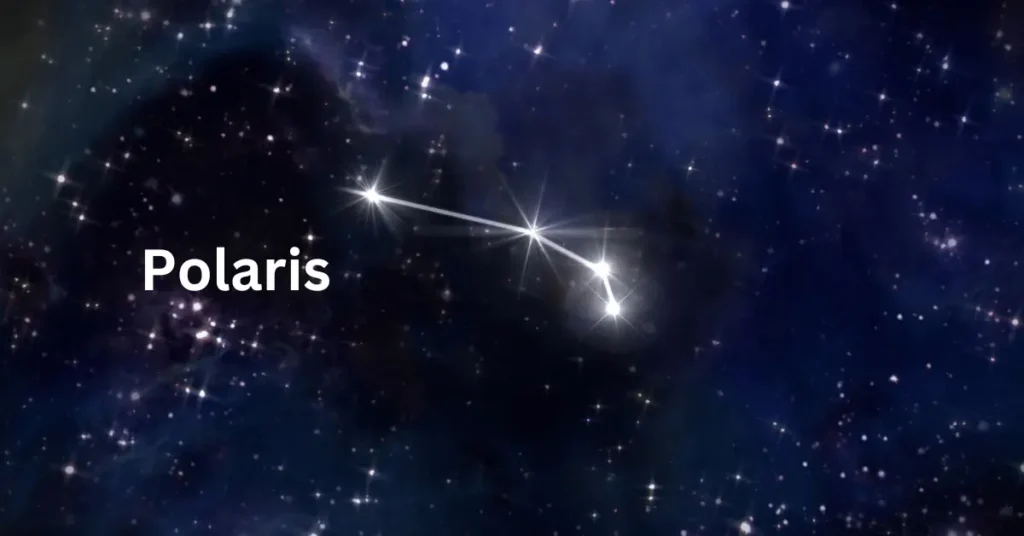
The term “North Star” has a straightforward yet fascinating history that ties back to its physical position in the sky and its cultural significance. Let’s break down the origin of the name and explore its linguistic and historical roots.
The Name “North Star”
The name “North Star” comes from the star’s unique position in the sky. It is the star closest to the North Pole, meaning it lies almost directly along the Earth’s northern axis.
The word “north” in the name is a clear reference to the star’s location in the northern sky, guiding those in the Northern Hemisphere.
The term “star” is simply a designation for any celestial body that appears as a point of light in the sky, which is how humans perceive Polaris, despite it being a massive star, much larger than our Sun.
The Ancient Term “Polaris”
The North Star is also known by its more formal astronomical name, Polaris. The name “Polaris” is derived from the Latin word “polaris,” meaning “of the pole,” referring to its position nearly aligned with the Earth’s north celestial pole.
The word “pole” here is used to indicate the axis around which the Earth rotates. The Latin term is a direct reference to Polaris’s role as the star that points toward the north pole of the Earth.
Historical References
The North Star has been recognized in various cultures and languages for thousands of years. In Ancient Greek, the star was referred to as “Phoenice,” meaning “the one at the pole.”
In medieval European astronomy, it was often called “Stella Polaris,” with “Stella” meaning “star” in Latin, and “Polaris” emphasizing its polar alignment.
In many ancient civilizations, the North Star was a prominent and stable feature of the night sky. It was often used as a reference point for navigation, which helped solidify its importance in both language and culture.
Cultural Significance
The name “North Star” has also been closely linked with concepts of guidance and hope.
In many Native American cultures, the North Star is seen as a beacon, guiding people on journeys or in times of uncertainty.
The idea of a “guiding star” or “steady point” is reflected in its linguistic uses, not only as a navigational tool but also as a symbol for finding direction in life.
Evolution of the Term
Over time, the term “North Star” became the common name used to describe Polaris in English. This evolution can be attributed to the star’s prominence in the Northern Hemisphere.
As sailors, explorers, and navigators began using the North Star for orientation, the term became synonymous with “true north,” a reliable and unchanging point in the vast expanse of the night sky.
Today, the term “North Star” has evolved beyond its astronomical roots to symbolize something that serves as a guiding force or unwavering direction.
People might refer to their personal goals or guiding principles as their “North Star,” indicating a sense of constancy and direction in their lives.
In Summary: The word “North Star” comes from the star’s essential role as a fixed point in the northern sky.
Its name, “Polaris,” has Latin origins, relating to its proximity to the Earth’s north pole.
Historically and culturally, the North Star has been more than just a celestial object – it’s a symbol of guidance, stability, and hope, with its linguistic roots reflecting this vital role.
FAQs
What is the North Star?
The North Star, also known as Polaris, is a star located nearly directly above the Earth’s North Pole. It appears to stay in the same position in the night sky, making it a reliable reference point for navigation. Unlike other stars that move across the sky, the North Star remains nearly stationary, helping travelers and sailors find true north.
Why is the North Star important?
The North Star is important because it serves as a constant point of reference for navigation. Its fixed position in the sky has made it invaluable for centuries, especially for sailors and explorers who use it to determine direction in the Northern Hemisphere. It has also been a symbol of guidance, stability, and hope in various cultures.
Is the North Star the brightest star in the sky?
No, the North Star is not the brightest star in the sky. The brightest star is Sirius, located in the constellation Canis Major. While Polaris is bright enough to be easily visible, its importance comes from its location in the sky rather than its brightness.
Can the North Star be seen from anywhere on Earth?
The North Star is primarily visible from the Northern Hemisphere. It is located almost directly above the North Pole, so it is visible to people living in the northern part of the Earth. In the Southern Hemisphere, Polaris is not visible, as it lies too far north in the sky.
How can I find the North Star?
To find the North Star, locate the Big Dipper constellation (part of Ursa Major). The two stars at the end of the Big Dipper’s bowl point directly to the North Star. Once you identify these stars, simply follow the line they form to find Polaris. It will be the star that remains nearly stationary in the sky while others appear to move.
Conclusion
The North Star, or Polaris, is much more than just a bright star in the sky. It has been a key tool for navigation for centuries, helping sailors, explorers, and travelers find their way.
With its fixed position above the Earth’s North Pole, it offers a reliable point of reference for true north.
Whether you’re using it for navigation or seeing it as a symbol of guidance and stability, the North Star continues to hold an important place in both astronomy and culture.
So next time you look up at the night sky, remember that this special star has been guiding people for generations!
Extra Points About the North Star
- Polaris Isn’t Always the North Star: Due to the Earth’s slow wobble, called “precession,” the North Star has not always been Polaris. In the past, stars like Thuban in the constellation Draco served as the North Star. In about 12,000 years, a different star, Vega, will take over this role.
- It’s Not the Brightest, But It’s Steady: While Polaris is not the brightest star in the sky, its special position above the North Pole makes it a steady and reliable guide for navigation. Its consistency is what makes it so important.
- Cultural Symbol: The North Star is more than just a navigational tool. It has been a symbol of hope, guidance, and perseverance in many cultures throughout history. For example, it played a key role in the journey of enslaved people escaping to freedom in the United States, guiding them toward the north.
- Part of Ursa Minor: The North Star is part of the Ursa Minor constellation, also known as the Little Dipper. The two stars at the end of the Big Dipper’s bowl point directly to it, making it easier to locate in the night sky.
- Navigating by the North Star: In the past, travelers would use the North Star to determine direction even in the dark of night or during storms. It has always been a reliable tool for those needing to find their way, especially in unfamiliar places.