Abacus Meaning
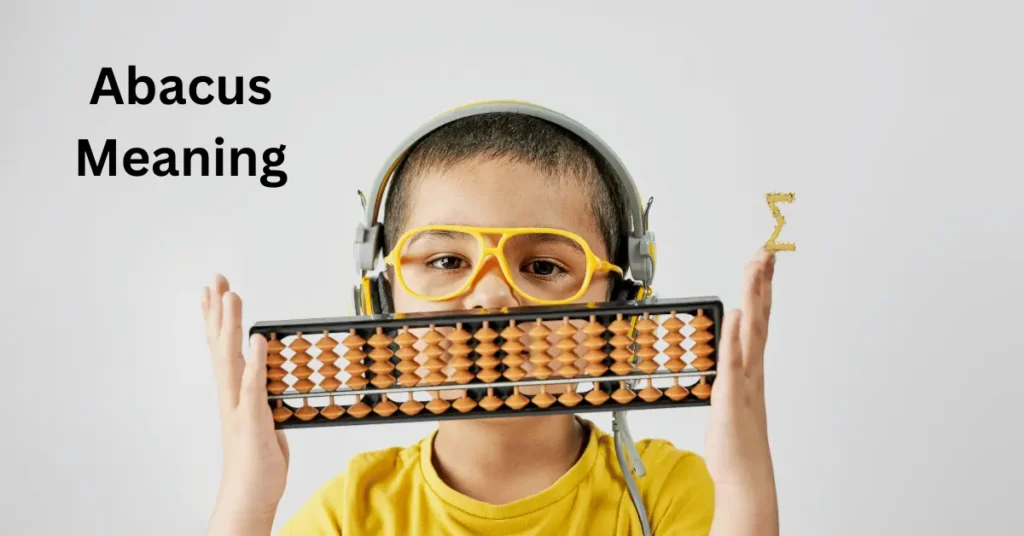
Have you ever wondered how people did math before calculators and computers? Well, one of the oldest and simplest tools used for calculations is the abacus!
The abacus meaning is simple yet powerful—it’s a tool made up of beads that slide along rods, helping people perform arithmetic operations like addition, subtraction, multiplication, and division.
Despite being around for thousands of years, the abacus is still used today in many parts of the world, especially for teaching kids math.
In this post, we’ll dive into what the abacus is, how it works, and why it’s still important even in our tech-savvy world!
What Does It Mean?
An abacus is a simple, ancient calculating device that consists of a rectangular frame with several rods or grooves.
On each rod or groove, there are beads that can be moved back and forth. The beads represent numerical values, and by manipulating them, users can perform various arithmetic operations such as addition, subtraction, multiplication, and division.
Each rod or groove typically represents a specific place value, such as ones, tens, hundreds, and so on. In some versions of the abacus, like the Chinese Suanpan, each rod contains two beads in the upper section (representing a value of five) and five beads in the lower section (representing a value of one).
By moving the beads towards the center or the edges of the frame, you can add or subtract values, helping to visualize the numbers and their relationships.
The abacus is more than just a counting tool; it’s a method of visualizing numbers and performing mental calculations.
While the device itself may seem simple, it is incredibly effective for developing a deep understanding of mathematical concepts, especially place value and the decimal system.
Even though we now use calculators and computers for complex math problems, the abacus meaning extends beyond just being a physical tool.
It plays an essential role in education, helping children learn math in a hands-on way.
Using the abacus, students can strengthen their mental math abilities, building the foundation for more advanced arithmetic and problem-solving skills.
Definition of Abacus Meaning
The abacus is a traditional counting device that has been used for centuries to perform arithmetic calculations. It consists of a rectangular frame with parallel rods or grooves, and each rod holds a series of movable beads. These beads represent numerical values, and by sliding them back and forth, users can perform calculations such as addition, subtraction, multiplication, and division.
In its simplest form, each bead on a rod represents a unit value (such as 1), and the position of the beads reflects the place value (ones, tens, hundreds, etc.). The abacus is often considered a tool to help visualize and manipulate numbers in a tangible way, making it easier to perform calculations without relying on written numbers or modern calculators.
Examples of Abacus Meaning
Basic Addition Example: Imagine you want to add 5 + 3 using an abacus. You would start with 5 beads on the “ones” rod, and then move 3 more beads toward the center to represent the additional value. After doing this, the total number of beads on the “ones” rod will be 8, which is the sum of 5 + 3.
Subtraction Example: Let’s say you need to subtract 7 from 12. Start with 12 beads on the “ones” rod. To subtract 7, you move 7 beads back to the starting point of the rod. After this, you’ll have 5 beads remaining, showing the result of 12 – 7 = 5.
Multiplication Example: For multiplication, suppose you want to multiply 3 by 4. First, you would place 3 beads on one rod. Then, to represent the multiplier (4), you would repeat this step four times, creating four sets of three beads. The total number of beads would be 12, showing the product of 3 × 4 = 12.
Division Example: To divide 12 by 3, you would start with 12 beads on the “ones” rod. Then, you would divide these beads into three equal groups, placing 4 beads in each group. This demonstrates that 12 ÷ 3 = 4.
Using the abacus, calculations are visual and hands-on, which helps users understand the logic behind mathematical operations.
The abacus meaning is more than just performing math; it’s about learning to visualize numbers, understand place values, and develop mental math skills.
This is why it remains an effective tool for teaching arithmetic, especially for young learners or those with learning difficulties.
Word Origin of Abacus
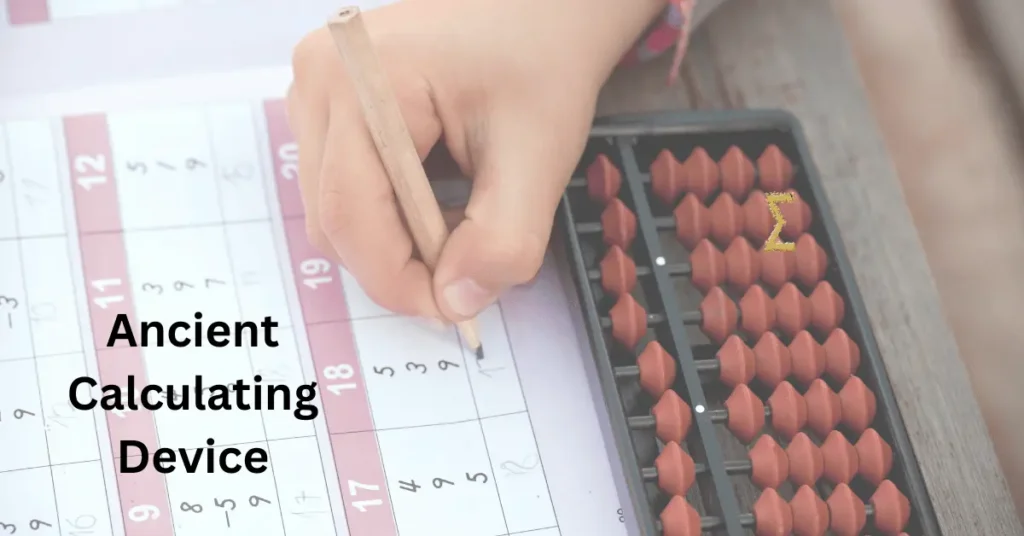
The word abacus has an interesting and ancient history, tracing its roots back to several languages and civilizations.
The term itself is believed to have evolved from the Greek word “abax” (ἄβαξ), which means “board” or “table.”
This refers to the flat surface that was used by early cultures for calculations and counting, before the abacus as we know it today was developed.
The Greek word abax is thought to come from the Semitic root “b-k-s”, which means “to calculate” or “to count.”
This root is reflected in the Arabic word “al-abāq” (الآباق), meaning “dust” or “sand,” as ancient peoples would often use dust or sand on a flat surface to draw numbers or perform calculations.
In fact, early civilizations like the Babylonians and Egyptians are believed to have used sand and a stylus to draw numbers and solve mathematical problems on flat surfaces, making the connection to the idea of a “counting board.”
The Latin word “abacus” was later adopted to describe the counting tool that evolved from the ancient practices.
The Latin term abacus specifically referred to a “small board with counters,” which was a precursor to the modern abacus.
By the time the Romans adopted the device, the abacus had evolved into a more structured counting frame with rows and columns for more efficient and organized calculations.
Over time, the word abacus spread across different languages and cultures, each adapting it to their version of the counting tool.
In China, it is known as the Suanpan, while in Japan, it is called the Soroban. Despite these regional differences, the fundamental concept of the abacus has remained the same: a simple yet effective tool for performing arithmetic calculations.
Thus, the word abacus has a long linguistic history that ties back to ancient counting practices, reflecting the development of this essential mathematical tool over centuries.
FAQs
What is an abacus used for?
An abacus is primarily used for performing arithmetic calculations such as addition, subtraction, multiplication, and division. It is a simple tool that helps users visualize numbers and understand basic mathematical concepts, often used for teaching math to children and enhancing mental calculation skills.
Who invented the abacus?
The abacus does not have a single inventor. It is believed to have been developed independently by several ancient cultures, including the Sumerians, Egyptians, Greeks, and Chinese, around 2300 BCE. The modern form of the abacus, such as the Chinese Suanpan and Japanese Soroban, evolved from these early counting devices.
How does an abacus work?
An abacus consists of rods or grooves with beads that can be moved back and forth. Each bead represents a specific value (usually 1 or 5, depending on the type of abacus). By sliding the beads along the rods, users can perform calculations. For example, moving beads toward the center or edges of the frame indicates adding or subtracting values.
Is the abacus still used today?
Yes, the abacus is still used today, especially in countries like China, Japan, and India. It is commonly used as an educational tool to help children and learners develop strong mental math skills. Some professional “abacus users” can perform calculations as fast as modern calculators, showcasing the power of this ancient tool.
What are the benefits of using an abacus?
Using an abacus helps improve concentration, memory, and mental arithmetic skills. It also provides a visual and tactile way of learning math, which can be more effective for some learners than traditional methods. The abacus enhances understanding of place value, number systems, and basic operations, making it a valuable educational tool for children and even adults.
Conclusion
In conclusion, the abacus is a simple yet powerful tool that has been used for centuries to perform calculations.
Despite being ancient, it remains a valuable educational tool today, helping people, especially children, develop strong math skills and improve mental calculations.
Whether for basic arithmetic or enhancing cognitive abilities, the abacus is a timeless device that continues to prove its importance in learning and understanding math.
Its easy-to-use design and hands-on approach make it a great way to explore numbers and improve mathematical thinking.
Extra Points
- Helps with Mental Math: Using an abacus regularly can improve your ability to do math in your head quickly and accurately, without needing a calculator or paper.
- Great for Visual Learners: The abacus provides a visual and hands-on way to learn math, making it easier for some people to understand complex concepts like place value and number relationships.
- Boosts Concentration: Since the abacus requires focus and attention, it can help improve concentration and memory, especially in children.
- Different Types of Abacuses: There are various types of abacuses, like the Chinese Suanpan, the Japanese Soroban, and the Russian Schoty, each with slightly different designs and uses.
- A Fun Way to Learn: The abacus can be a fun and interactive way to learn math, making it more engaging for kids and turning math practice into a hands-on experience.